Transparency
It’s important to me to be transparent about my creative process, my motivations, inspirations and form fascinations as well as the techniques & materials I use. Sharing the ‘why, how, what and where’ of my work is not just a formality but also part and parcel of what I do - it's the story.
Philosophy
Right from the start of my ‘career change’ to an artistic profession, I decided to prioritise working with old materials and techniques, off-the-grid when possible or justifiable. This was in part with sustainability and the necessary move towards circularity in mind, but also as a philosophy: to slow down and see the beauty in what has been left behind, to honour the past and use transformation to make the connection to the future.
This decision imposes some serious limitations on my design options while at the same time providing for a formidable creative challenge, and that is a good thing!
Trans-form-ation
#youseejunkiseejewels - The concept of what I do, is to see the potential of the old, rough or discarded, often of little to no value, and to transform it into something new, pretty, of value. Of value because of the labour I put into it – with my head, heart and hands – and the form I give it, all with a story behind it.
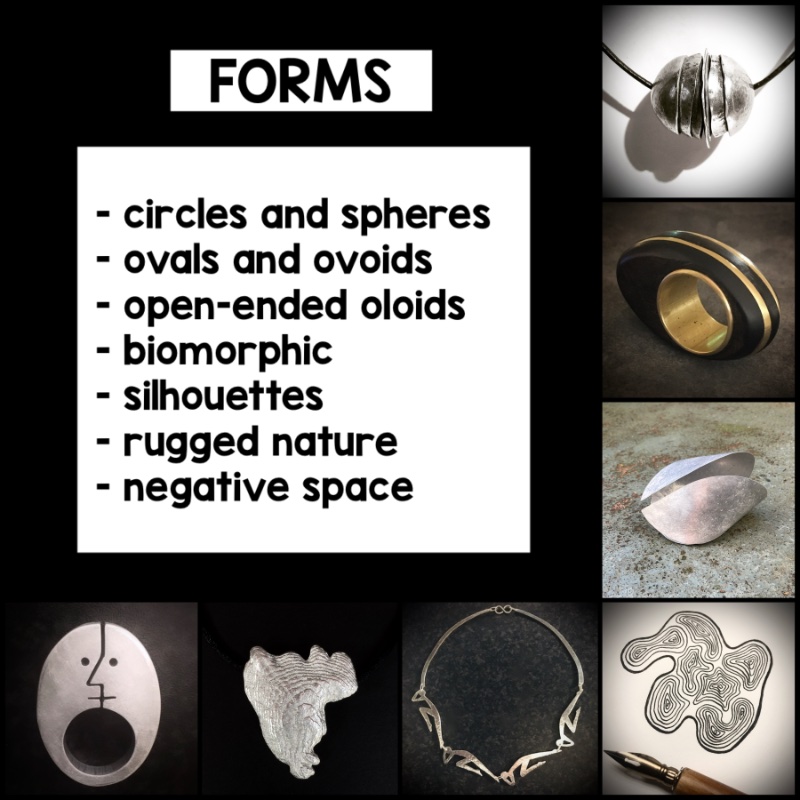
I am drawn to specific forms, especially bold organic forms and textures found foremost in nature and derivatively in my favourite 20th century art styles and movements like surrealism and biomorphic abstraction.
I have explored form since childhood and have added a dedicated section Finding Form with a curated collection of drawings, paintings and photographs that provide a deeper context to my three-dimensional work.
Metaphore
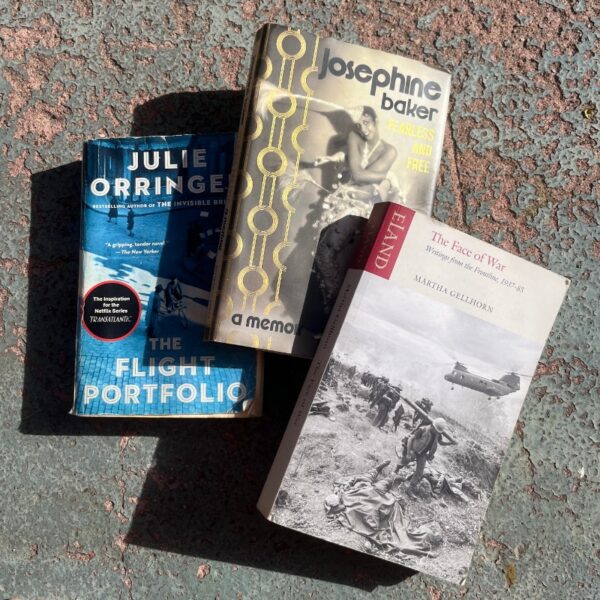
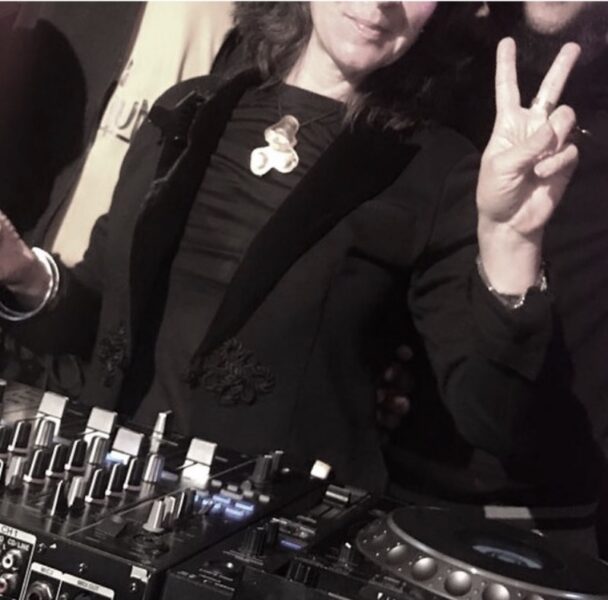
But there is more that feeds into my work than what I see in nature and visual art, like words, from literature and poetry to wise things people once said, from lyrics to political statements. Words matter. So does music. And dance! And last but not least: the state of the world. I am always looking for the metaphor in the metamorphosis.
For the record
Because the concept of transformation lies at the heart of what I do, being transparent about the process is part of the process.
Aside from taking photographs as an end in itself, I also take lots of photos along the way, during my creative process, of the beginning, the end result and everything in between. I appreciate the history of materials, some of my very old tools, and techniques that have been used for thousands of years. In my opinion they’re all extremely photogenic!
Some of my photos documenting my creative process are shown on the different series pages of jewels and objects as well as the Photos in Finding Form and you can also find me on Instagram where I keep more of a visual diary of my work.
Material
There is a difference between working with primarily old materials (or discarded offcuts), and working with materials ‘fresh off the shelf’ .
Firstly, my design process is often in reverse. Rather than drawing up a design for a ring or a small sculpture and then getting the necessary materials and tools, my starting point is to see what is available to me and then figure out what I can make with it that fits my aesthetic style and principles.
Secondly, my work involves a lot of laborious identifying, sorting, taking things apart, cleaning, straightening, getting rid of sharp edges and polishing before I actually make a piece.
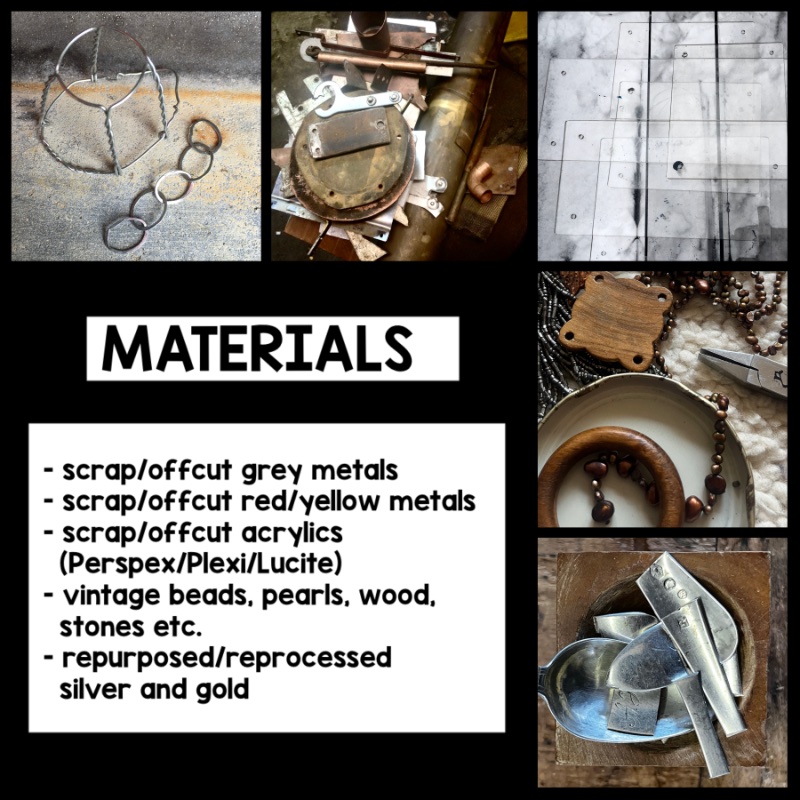
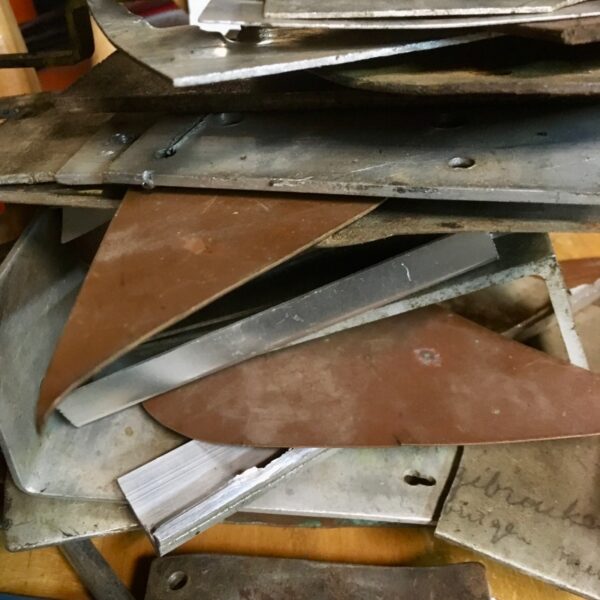
Thirdly, a significant difference between working with old or new material, is its traceability! My sources range from random finds on the street and the beach to thrift shops, auctions, bits and pieces I have collected over the years, the scrap metals and lucite offcuts box at the atelier where I work once a week and last but definitely not least: generous donors.
Traceability
Although I can describe where I found a material, or on the rare occasion bought it, or who gave it to me, for many materials it’s impossible - with the naked eye - to determine its original source, its exact composition or in the case of old base metals, the specific alloy (e.g. brass).
With vintage beads like pearls or with second-hand lucite this is generally not an issue but with some of the salvaged base metals I have, like vintage brass, this means they are workable for objects but not for jewellery (unless I would have it properly tested for the alloy which entails prohibitive costs).
When I started out with metalsmithing, I was mainly developing prototypes and worked with anything I could find. Along the way, I have shifted some of my sourcing towards offcuts (scraps leftover from work with new materials like base metals with a specified alloy) - offcuts from my own as well as colleagues’ creations. Although this is ‘scrap metal’, strictly speaking this is not ‘old’ but rather ‘discarded’ material!
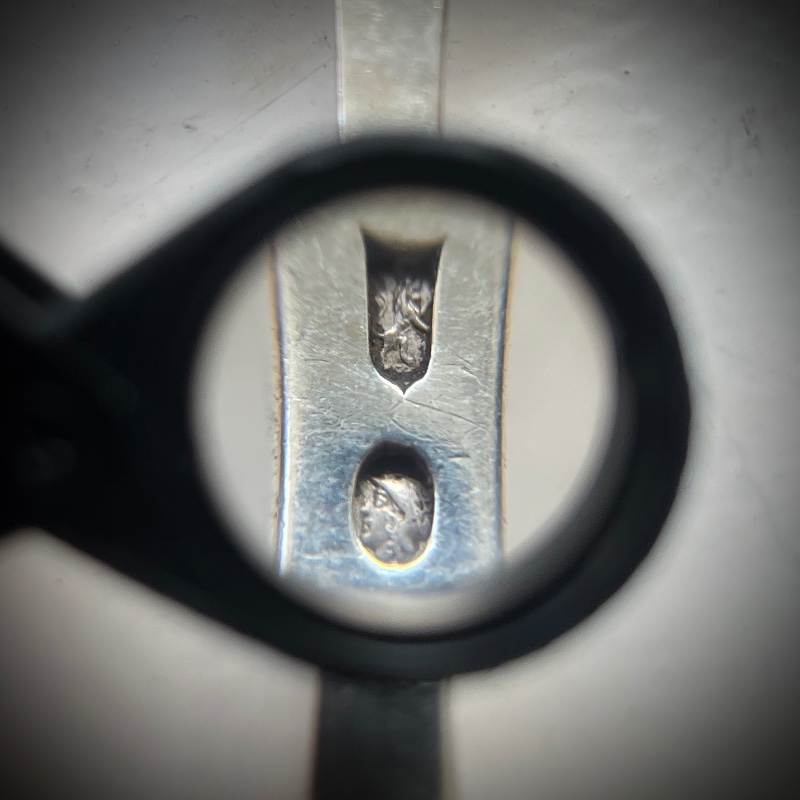
Luckily, silver and gold items are - in principle - hallmarked. This tells me something about the alloy (e.g. sterling silver is 925/1000 silver), the maker and the year in which they made it. But when someone donates an old silver spoon or broken bracelet, I know little to none about the circumstances under which the silver was mined and processed maybe a century ago. It does not classify as ‘green’ / ‘eco’ / ‘ethical’ silver.
Both silver and gold are infinitely reusable without losing its purity and qualities, and have been melted down and repurposed for over 6000 years - nothing new under the sun! So unless you buy it straight from the source (e.g. Fairtrade or Fairmined), it’s hard to impossible to verify or judge its whole history.
‘Recycling’
Sometimes I melt down silver or gold scraps to make wire or sheet but for some wire and especially ‘findings’ like ear posts and butterflies, I mostly resort to buying them, at a premium, from Cookson Gold, a company in the UK that provides ‘certified recycled’ precious metals. Although this ‘certified recycled’ silver or gold is guaranteed to not be newly mined, it says nothing about the original source or circumstances under which it came out of the ground.
Also, I should point out that the term ‘recycled’ is heavily debated in the jewellery industry. Some consider it a misnomer since ‘recycling’ officially refers to the reprocessing of waste (EU Waste Framework Directive 2008/98/EC art. 3(17)). And of course precious metals like silver and gold are unlikely to ever be thrown in the bin!
The unfortunate reality is that whether we buy ‘recycled’ or newly mined precious metals, we are all ‘drawing from the same well’. For a multitude of reasons, collective demand has pushed silver and gold prices to record highs in recent years. Despite civil society driven EU regulations, UN Frameworks, OECD Guidance and Industry Standards, soaring prices still fuel aggressive mining expansions, accelerating environmental damage and labour exploitation across the globe, not to mention geopolitical conflict.
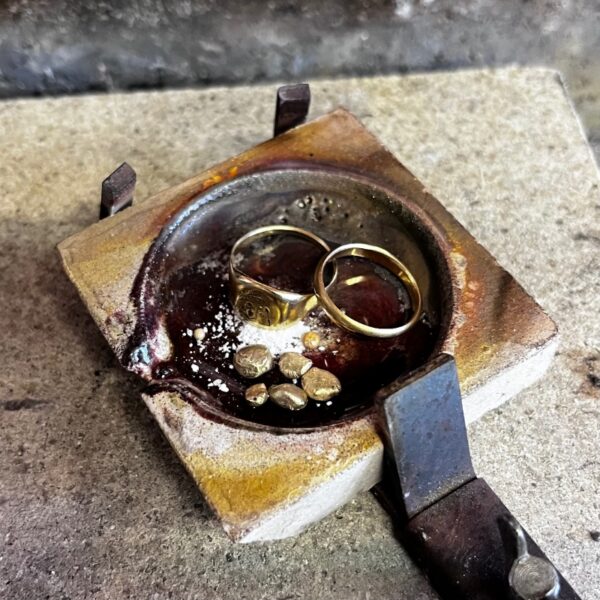
That’s why, when I work with silver, or on the rare occasion gold, I for the most part use donated or ‘bring your own’ old precious metals (like heirloom wedding rings) and refer to the transformed material as (directly) ‘repurposed’ or ‘reprocessed’ silver or gold, distinct from above mentioned ‘certified recycled’.
And when I work with scrap metal - base metal offcuts or salvaged pieces - this is also, technically speaking, not recycling but rather a matter of ‘upcycling’, ‘repurposing’ or ‘creative reuse’. Scrap base metals can be infinitely recycled but this process is managed by highly regulated industrial facilities and includes sorting, shredding, melting, purifying and refining before it’s ready to use by manufacturers for new products.
Of course, in an ideal world, if everyone reduced and reused (rather than repurposed or recycled), I would have little to work with!
Tools and techniques
When I started out with metalsmithing, learning about all the various tools and techniques, I was committed to trying everything once. Some techniques matched my desire to work mostly with old things, while minimising the negative impact, better than others. A few common metalsmithing techniques like filigree and etching were not for me. I’m still learning and I’ll keep trying new things, but in my daily studio practice I try to stay away from techniques involving toxins or endless patience.
The tools I use, depend in part on where I am working - more on that in My Studio. My favourite techniques are really the ones that allow me to work outside with basic old-fashioned hand tools like hammers, saws, files and punches. I bought some of these tools at a local wholesale supplier - Bijou Moderne - and some come from my family tool shed and brocante markets.
I made some punches and my first (unofficial) maker’s mark stamp at Atelier Drie, the studio where I work one day a week and where I have been taking metalsmithing lessons for many years under the wonderful guidance of Greetje Sieders. I made a few more punches as well as gravers in Egypt at Azza Fahmy’s Academy with super instruction by Sara Zaki. My official maker’s stamp was made by WaarborgHolland, the Dutch assay office that tests and hallmarks precious metals such as gold and silver.
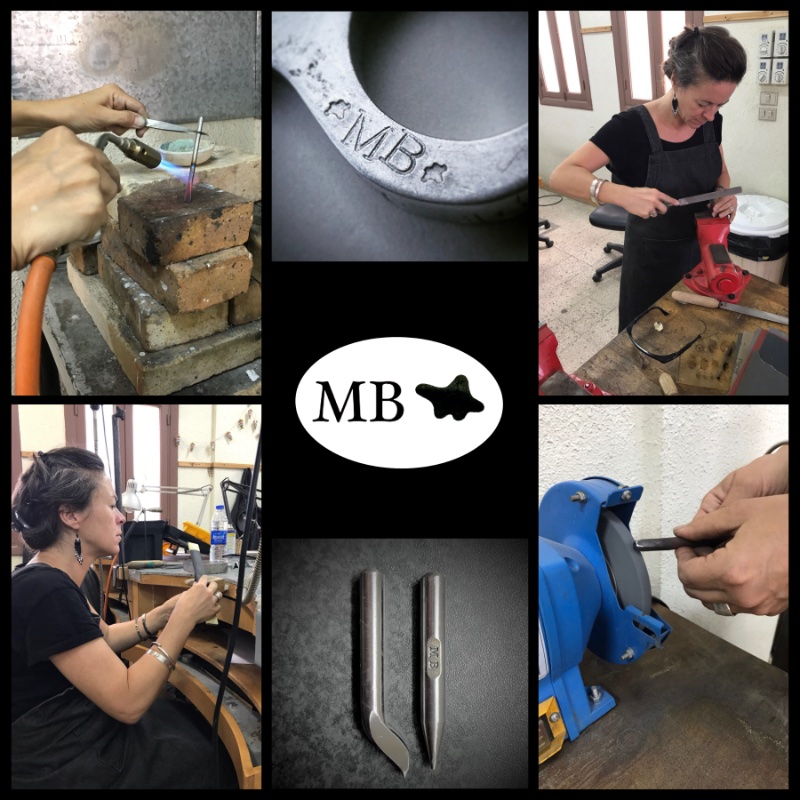
Whether I have made something in- or outside, on- or off-the-grid, right at the end most of my small metal work goes into my favourite electric piece of equipment: a rock tumbler, filled with little steel balls, for hardening and polishing metal (and pearls!). Another electric tool I sometimes use for particularly fine work like piercing with a tiny drill or texturing, is a Proxxon handheld power tool from HBM machines.
Most of the metalsmithing techniques that I use, are ancient and have unfamiliar technical names like planishing, raising, dapping, chasing and repoussé, annealing, reticulation and granulation. When and where applicable, I describe these in a little more detail per series of jewels or objects but the main factor with all these techniques is whether they are ‘cold’ (off-the-grid) or ‘warm’ (on-the-grid). The cold techniques allow me to work basically anywhere (with noise), preferably outside, and the warm techniques are generally more convenient inside (my kitchen or Atelier Drie).
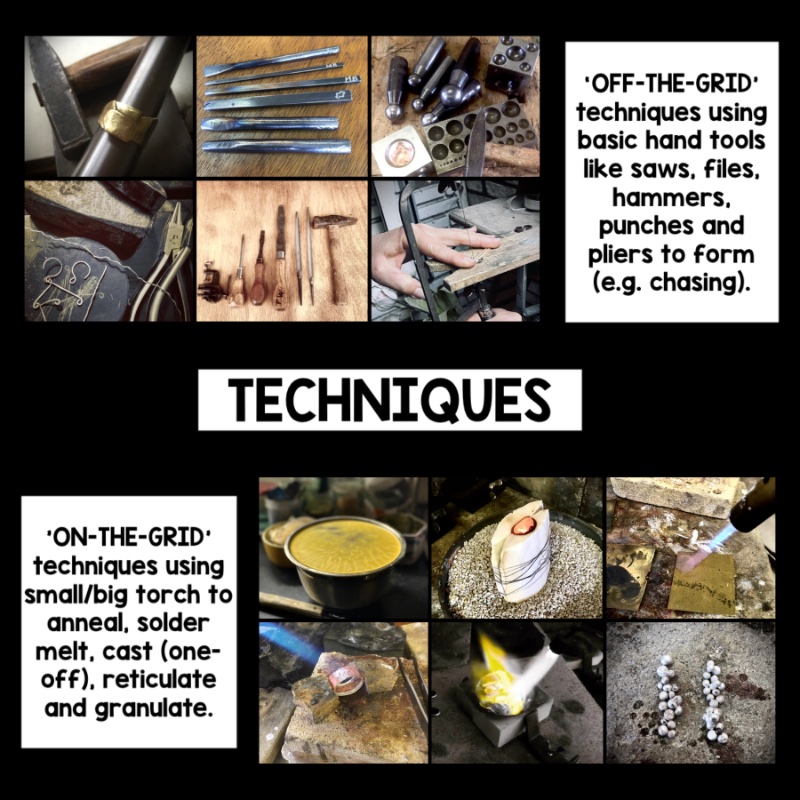
For chasing and repoussé (hammering relief into metal with punches), I use my own alternative ‘chasing pitch bowl’ that holds the metal securely while hammering forms. Mine is filled with dried beans covered in beeswax rather than the more common petroleum / resin based pitch. When I’m in a rush, I find that cork coasters from my kitchen work pretty well too!
The tools that I use for sculpting soapstone come from museum Beelden aan Zee, where I bought my first piece of this metamorphic rock. I started out with their soapstone kit and later bought more rocks from arts & crafts store Bertus Workel in the east of the Netherlands. All of these rocks come from countries on the other side of the world like Brazil and India. For these soft stones the technique consists of endlessly rasping, filing, sanding and polishing with beeswax.
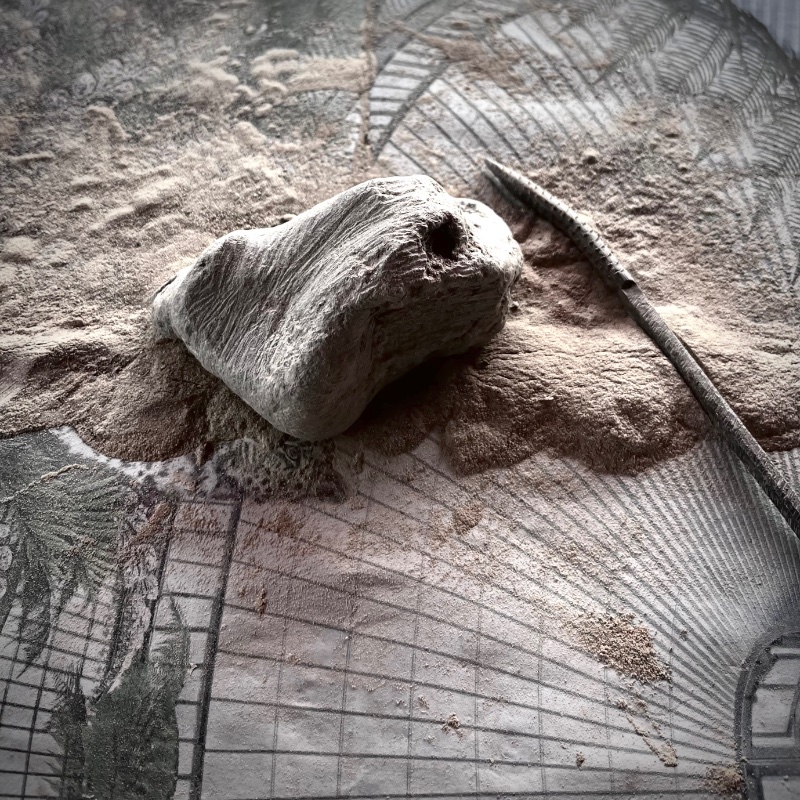
Recently, I found an atelier, ‘Vonmoosstein’, in Switzerland that sells offcuts from EU-sourced soapstone (from Finland). For these slightly harder rocks - still a work in progress - I bought my tools from local sculpture supplies shop De Beeldhouwwinkel. The technique with these harder stones includes carving with chisels as well as elaborate filing, sanding and polishing.
For my two-dimensional musings, I mostly use common arts & crafts supplies, apart from my camera/phone, and most of these are almost as old as I am or at least as old as my children are!
Digital presence
For this website, I collaborated with Hélène Mulder in Antwerpen who has specific expertise in working with artists on their digital presence. Not only did she create the technical side of this website but she was also key in helping me get my head and work organised so beautifully. What a wonderful journey!
We decided to work with the open-source content managing system ‘Word Press’ and the licensed WP media library folders by ‘Filebird’. I chose a local host in Amsterdam, ‘Greenhost’, because they hold sustainability as a fundamental pillar of their business and also take an active stance on internet freedom, digital security and human rights. The content of this website is also stored with Proton, a Swiss corporation committed to privacy and internet freedom and whose primary shareholder is the non-profit Proton Foundation based in Geneva, Switzerland.
On Instagram and Bluesky, I intermittently post photos of my creations and everything in between and on Linkedin I sometimes share more in depth stories related to my work.
If you would like any more information on my ‘why, how, what and where’, please feel free to get in touch.